The Importance of Learning from History
It is often said that we always need to learn from history. So which history is it that we need to learn from most?
Dan Lamb
3/18/20267 min read
Can all of history be considered important enough to learn from?
There are many times when we watch the news and may feel we are living with events of history in our own time. With events we are seeing in the world today, we can only hope that the whole of humanity is learning lessons from what has happened in the past. However most of us do not have one finger on a nuclear button, and so in our own lives there are only certain domains that we can affect with our decisions - meaning that we need to work out which history is important for us to learn from, with the kind of decisions we make.
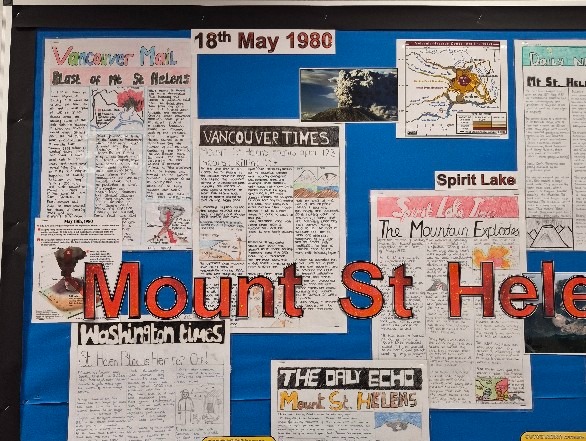
I have always found history fascinating and achieved an 'A' at 'A' Level - but one of the main things I learnt was how vast the scope of all of history is! An exam curriculum cannot possibly cover everything in history which has been experienced by all the people on all nations of the world. In distilling history, are we subconsciously saying that some people's history is not as important as others? In other words, who decides what counts as 'history' and what doesn't? There are times when well-known people such as kings and presidents feature in history, but there are also times when 'ordinary' people are at the centre of historical events - and there are other events from the past which might not feature in the study of 'history' because they cross over into other areas of study . On a tour of a school recently I was very interested to see this display board in a geography classroom, featuring an important event of geological history.
You may not even have heard of the eruption of this volcano: Mount St Helens in north-west USA, near Canada. Although I was not old enough at the time to have paid any attention to it (!) this is one of the most significant historical events of my lifetime – even though it might not appear so at first.
Certain events from history are known from all kinds of fragments and documents of historical records which are held by museums and universities around the world: this is the kind of thing that comes to mind when we think of the study of history. Some are one-off accounts of an event, whilst others are multiple records of the same event or events. These might be about battles, or matters of intrigue featuring kings and queens, or personal experiences - such as diaries most people will have heard of, including Samuel Pepys or Anne Frank.
It is not only from written records that we can piece together events of history. Geology and archaeology also provide evidence of different events, even when it is not a written record by people from the times. These require a level of interpretation, which therefore also requires people to carry out a validation process.
Critical thinking is an important part of our understanding of the world. We all do this instinctively, if for example we hear about something which does not fit with our understanding of how the world works. If someone told me they had seen a dog in the driving seat of a large toy car and steering it, I would believe it was a dog sitting in a remote controlled car as opposed to it being a dog genuinely driving the car.
It is necessary to evaluate the truth of historical documents in this way too - this is in fact an important part of what academic and professional historians do. It has been said that 'history is written by the winners,' meaning that their account of the story is the one which is recorded as official history. In times from before newspapers and the internet it is easy to see how there might be only one side of a story which survives - for example if a dictator in government was crushing opposition to his rule.
It might seem obvious to say it, but if there is only one copy of any record of history, this is technically less reliable than if there are multiple copies of the same records: historical authenticity is strengthened when there are more copies of the same document or more documents of the same events being recorded. This is not to say that something should automatically be doubted as untrue if there is only one known record of it – however in order for someone to disbelieve it, it would be reasonable to expect them to have some evidence of why.
It might surprise you to know that texts of the Bible provide us with the most multiple copies of the same records of any events in history from before the invention of printing presses. Not only that, but archaeological records have often been found which back up previously known accounts of history, including many events recorded in the Old Testament. Many of these can be found in the British Museum in London, although the most interesting difference between documented records of history and the evidence from museum history is that we have to interpret the dating of any events in ancient geology or archaeology.
This is where Mount St Helens comes in. The eruption of 1980 is recorded history where there can be no doubt of how many years ago it happened.
This is in contrast to many areas of geology where there are no written documents to say exactly what happened to create the rock layers where fossils are found, such as for example the dinosaurs. No museum has a diary entry by an ancient historian which was buried at the same time as any fossils, giving us details of the events surrounding their formation. So interpretation is required to construct a picture of how the rock layers were formed.
Predominant thinking currently appears to be that these rock layers were formed one on top of the other over a period of millions of years - and for a period of some of the 20th century it may have been thought by many that there could be no other way.
If you went to look at the rock layers and geological formations at Mount St Helens today, you might also think they are indistinguishable from other rock layers around the world which are thought to be millions of years old.
But of course, there is no need to consider different theories and interpretations of these specific geological features, because photographs exist from before and after the eruption of 1980, and place the impact of this event in history.
At Mount St Helens, eight metres of finely-layered sediment were deposited in just one hour. This is more than just interesting, because there are two ways to look at the impact of events which have caused many features of geology and natural history - slow erosion or build-up over a very long period of time, or rapid erosion or build-up over a very short period of time.
Both theories are held by people in the scientific world with much better qualifications than me. However the evidence of Mount St Helens shows that the theory of sudden geological formation (known as 'catastrophism') is scientifically valid - and is backed up by observable evidence.
Why is this so important? - because this evidence makes it entirely reasonable on a scientific basis to believe a historical theory that dinosaurs and other fossils could also have been buried, in their locations in rock layers, by eruptions and floods of lava, combined with increased water levels. This would fit with other historical evidence which is documented in records provided by the Bible.
And so, is this just interesting history, or is it history that we need to learn from?
We all have certain decisions that we need to make in our own lives: we might not all be able to govern a nation or run a multi-national business, but do we feel we need to learn from history in the decisions which affect our own lives and those around us?
For myself: I am interested in history and want to learn from it. And so, this is the reason I consider the Mount St Helens eruption one of the most significant historical events of my lifetime: it has a knock-on effect in terms of questions of life's bigger picture.
We are all surrounded by a swirling viewpoint that the world is millions of years old, but in fact there is evidence to show that this is not the only conclusive scientific verdict available to us. Different branches of science also contribute to the weighing up of this question - for example the complexity of DNA and life's design features, and the lack of 'missing links' in evolution.
History is important because it speaks to us now, and provides us with the foundation of everything that we see in our world today. And yet there are still different interpretations of history which do not overlap.
To work out how each one of us sees history, it is a question of considering all the evidence available - including all documented history of many kinds, and all interpretations of understanding the natural world around us, through biology, geology, and every other branch of scientific study.
And what it comes down to is this: whether we will make a decision on how much we will choose to learn from history, or ignore it.
About Dan's blogs:
I don't expect everyone to agree with everything I write - but hopefully my blogs do give readers something to think about.
Throughout my own life I have found that it is good to be challenged on the views I have held at different times, and the worldview that I now hold: we cannot hold to strong and effective values if these do not have solid foundations. So one part of the reason for my blogs is to help people examine why they hold the values and views that they have. This is a part of my training as a Life Coach, which is to enable clients to see ways in which their lives align with their own values and ways in which they don't - not to try to persuade others to align themselves to the Life Coach's worldview.
After all, no one should want to make the world full of clones of themselves - that would remove all the beauty of the diversity which is the hallmark of our incredible mind-blowing and unfathomable universe.